

Hey there! As a supplier of Oil Resistant Rubber Rain Boots, I often get asked a bunch of questions about our products. One of the most common queries I've been getting lately is, "Can oil resistant rubber rain boots be used in extreme cold?" Well, let's dive right into this topic and find out.
First off, let's talk a bit about what makes our oil resistant rubber rain boots so special. These boots are designed to withstand contact with various types of oils, which is super useful in industries like manufacturing, automotive, and oil and gas. The rubber material used in these boots has been treated and formulated to resist the damaging effects of oil, such as swelling, cracking, and degradation. This ensures that the boots maintain their integrity and functionality even when exposed to oily substances on a regular basis.
But what about extreme cold? When the temperature drops significantly, the properties of rubber can change. Rubber is a polymer, and in cold temperatures, it can become stiffer and less flexible. This is due to the fact that the molecules in the rubber slow down and move less freely as the temperature decreases. So, the big question is, how does this affect the performance of our oil resistant rubber rain boots in extreme cold?
Well, it depends on a few factors. The type of rubber used in the boots plays a crucial role. At our company, we use high - quality synthetic rubbers that are formulated to have better cold - resistance properties. These rubbers are engineered to remain flexible at lower temperatures compared to traditional rubbers. However, even with these advanced materials, there is still a limit to how cold the boots can handle.
Most of our oil resistant rubber rain boots are rated to perform well in temperatures down to around - 20°C to - 30°C. In this temperature range, the rubber will still be flexible enough to allow for normal movement and walking. The boots will also maintain their oil - resistant properties, as the cold does not directly affect the chemical resistance of the rubber against oil.
But if the temperature drops below this range, say to - 40°C or lower, the rubber may start to become too stiff. This can make the boots uncomfortable to wear, as it restricts the natural movement of your feet and ankles. In extreme cases, the rubber may even become brittle and crack if subjected to excessive bending or impact. When the rubber cracks, it can compromise the integrity of the boot, potentially allowing water and oil to seep in.
Another factor to consider is the insulation of the boots. While the focus of our oil resistant rubber rain boots is on oil resistance and waterproofing, we also understand the importance of keeping feet warm in cold conditions. That's why many of our boots come with insulation layers. These layers can be made of materials like Thinsulate or wool, which provide additional warmth. The insulation helps to keep your feet at a more comfortable temperature and also reduces the impact of the cold on the rubber.
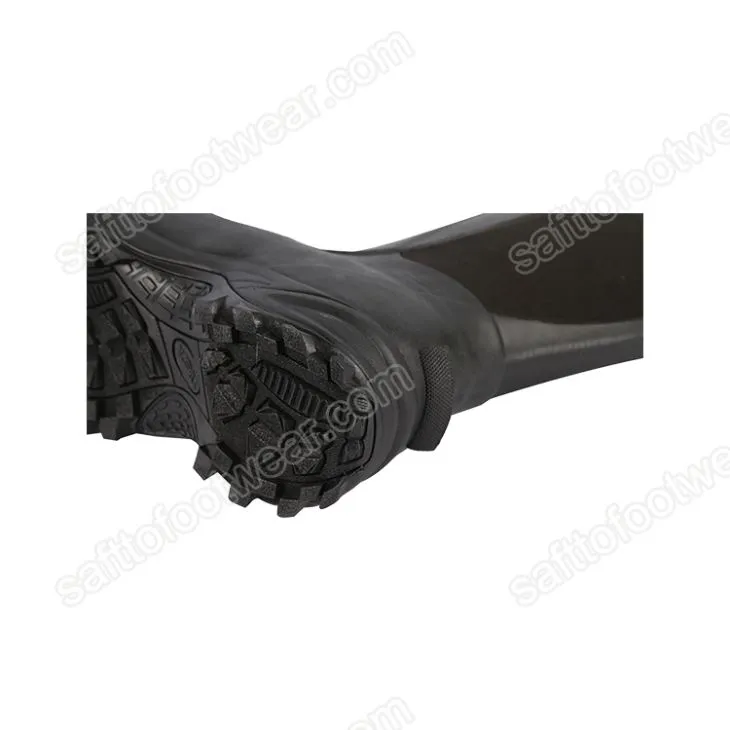

Now, let's talk about some of the other features of our boots that are relevant in extreme cold. Our Breathable Outdoor Rubber Boots are designed to allow air to circulate inside the boot. This is important because in cold conditions, your feet can still sweat, and if the moisture is trapped inside the boot, it can make your feet cold and uncomfortable. The breathable design helps to keep your feet dry and warm by allowing the moisture to escape.
Our Anti Corrosive Waterproof Rubber Boots are not only resistant to oil but also to other corrosive substances. In extreme cold, there may be chemicals like de - icers on the ground, and these boots can protect your feet from any potential damage caused by these substances.
And for our female customers, we have Womens Marsh Waterproof Rubber Boots. These boots are designed with a more feminine fit and style, while still providing the same high - quality oil resistance and cold - weather performance as our other boots.
So, in conclusion, our oil resistant rubber rain boots can be used in extreme cold to a certain extent. If you're working in an environment where the temperature is within the rated range of the boots, they will perform just fine. They'll keep your feet protected from oil, water, and the cold. But if you're going to be in extremely cold conditions below the rated temperature, you may want to consider some additional precautions.
One option is to wear thick, insulated socks inside the boots to provide extra warmth. You can also look into adding insole heaters, which are small battery - operated devices that can keep your feet warm. Another thing to do is to limit the time you spend outside in the extreme cold. If possible, take breaks in a warm area to allow your feet and the boots to warm up.
If you're in an industry where you need oil resistant rubber rain boots that can perform in cold conditions, we've got you covered. Our team of experts is always available to help you choose the right boots for your specific needs. Whether you're working in a cold warehouse, an oil rig in a cold climate, or just need a reliable pair of boots for outdoor winter activities, we have the products for you.
If you're interested in learning more about our oil resistant rubber rain boots or other products like Breathable Outdoor Rubber Boots, Anti Corrosive Waterproof Rubber Boots, and Womens Marsh Waterproof Rubber Boots, feel free to reach out to us. We're more than happy to discuss your requirements and guide you through the purchasing process. We can provide you with detailed product information, pricing, and even samples if needed. So, don't hesitate to contact us for any procurement needs or just to have a chat about our amazing boots!
References
- "The Physics of Rubber in Cold Temperatures" - Journal of Polymer Science
- "Cold - Weather Performance of Synthetic Rubbers" - Rubber Technology Magazine
- "Insulation Materials for Footwear in Extreme Cold" - Footwear Research Journal